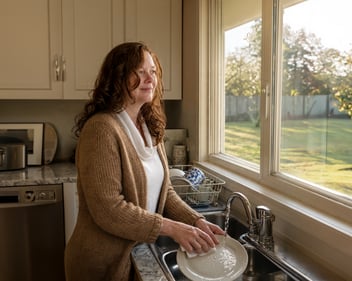
For Rodney Squires, caregiving begins long before something is said out loud.
It begins with noticing.
Before becoming a professional caregiver, Rodney spent nearly 30 years as a Registered Massage Therapist. That work taught him to pay attention to what people do not always say directly: a change in expression, a shift in energy, a hand reaching out, a moment of hesitation.
Today, those instincts help him care for a longtime MedicAlert member who now lives with dementia.
Rodney first began working with her household in 2020. As her health needs changed, so did his role. Today, he helps oversee her care, coordinates the people around her, and supports the systems that allow her to remain safely at home.
For Rodney, caregiving is not only about managing care. It is about protecting the person inside the illness.
“She is a person first,” he says. “That is the first thing you have to see.”
Rodney’s client has worn a MedicAlert ID for 30 years. Long before dementia became part of her story, her bracelet helped communicate a complex medical history, including serious illnesses and major surgeries. It was not something she had to be reminded to wear. It was part of how she took care of herself.
Rodney says he never saw her without it.
As dementia progressed, her MedicAlert record was updated to include new risks, including disorientation and wandering. For Rodney, making that update brought relief.
He knew that if she ever became separated from the people caring for her, first responders or a Good Samaritan would not have to guess. They would have access to the information they needed.
That mattered because, for a time, she was still mobile, friendly, and engaging to everyone she would encounter. To someone passing by, she might not have appeared to be in distress. She would smile, chat, or continue walking — but not know how to get home.
There was one frightening incident when she became lost while walking along a hiking trail in the countryside. With the help of the Ontario Provincial Police, thankfully, she was found safely. But for Rodney, it confirmed what every caregiver knows: preparation matters.
Today, her needs have changed again. She is receiving palliative care. She no longer speaks. Swallowing has become difficult. Communication now happens through expression, routine, touch, trust, and the careful attention of the people around her.
And still, Rodney sees her.
He sees it in the way she responds to familiar voices. In the smile that appears when someone she trusts walks into the room. In the small moments that remind everyone around her that illness has changed many things, but it has not erased the person.
Her MedicAlert bracelet remains part of that circle of care, and for Rodney, its purpose is now deeply simple. “It does exactly what she cannot do,” he says. “It speaks for her.”
That is what makes MedicAlert so important from a caregiver’s perspective. It is not only there for the person wearing it. It is there for the people caring for them, too.
In a crisis, Rodney says, even the most prepared caregiver can become overwhelmed. A family member may forget an important detail. A support worker may not have every piece of information. The caregiver could even be the one facing an emergency.
MedicAlert helps close that gap.
It means Rodney does not have to carry what he calls “a Rolodex of information” in his head at every moment. It means another caregiver can take her outside with confidence. It means that if something unexpected happens, her critical information is still available.
For Rodney, that makes MedicAlert more than a bracelet. It is a safety net. It is a tool. And in caregiving, tools matter. There are supplies, schedules, medications, appointments, care providers, comfort measures, and safety plans. Rodney believes MedicAlert belongs on that list.
In fact, he says, it belongs at the top.
Because caregiving is full of things no one can completely control. But MedicAlert gives caregivers one more way to protect the dignity, safety, and personhood of someone they love or care for professionally.
For 30 years, MedicAlert has helped this longtime member carry her health information with her. Through major health challenges, through dementia, and now through a stage of life when she can no longer speak for herself, it has remained a constant.
For Rodney, that constancy is invaluable. As a caregiver, he says, he would never be without MedicAlert.
Are you a caregiver for a loved one with a chronic medical condition? Learn how MedicAlert can provide peace of mind, protection, and support at medicalert.ca/signup or call 1-800-668-1507 today.
Are you a MedicAlert subscriber and would like to share your story? We would love to hear from you! Share your story.