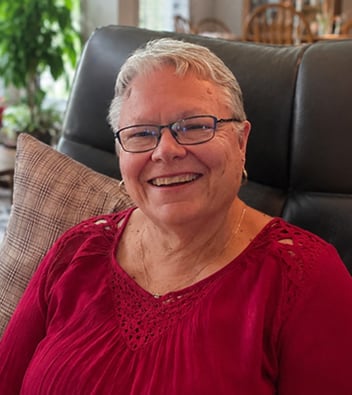
When Claire woke up after her double lung transplant, the first thing she noticed wasn’t pain—it was silence.
For most of her life, her breathing had never been quiet. Far from it.
Growing up in Elliott Lake, Claire lived with chronic lung infections so severe that doctors removed part of her lung when she was just ten years old. Even then, they couldn’t fully explain what was wrong. She learned to live with it.
“It was just how I breathed,” she says. “It was loud.”
For years, that was simply her normal. The people closest to her learned to read the subtle changes, like her husband, Yves—her high school sweetheart and partner of 57 years. They have always played cards together, with Claire typically the winner. But over time, Yves began to notice something. “As soon as I started beating her,” he says, “I knew she was getting sick.” Hours later, she would be.
It wasn’t until her early 40s that Claire was finally diagnosed with a rare lung disease—one so uncommon that only a few hundred people in the world are believed to have it. By then, her body had already adapted in ways that masked how serious her condition was. She retained carbon dioxide instead of releasing it properly, leaving her with dangerously low oxygen levels.
A few years later, a serious infection sent her to hospital in Toronto where she spent three weeks slipping in and out of a coma. Doctors determined she needed a double lung transplant to survive. She was placed on the transplant list—and within days, a donor match was found.
In November 2012, she received new lungs.
After the surgery, Claire was afraid to come off the ventilator. Even when doctors told her she was ready, she asked for one more day. When she finally did, everything felt different.
“My breathing was so quiet,” she says. “I kept asking myself—am I breathing?”
It was during her recovery that a nurse first suggested she wear a medical ID. Yves went down to the hospital pharmacy to look at options, but nothing felt right. The next day, Claire mentioned it to another nurse.
That’s when the nurse reminded her about MedicAlert. “The others are functional, but they certainly don’t have the emergency health record and all of the other services that connect you to first responders.”
Before she left Toronto to return home to Northern Ontario, she already had MedicAlert on her wrist and an extensive emergency health record she keeps up to date whenever there is a change in her medical profile.
More than a decade later, Claire still wears a MedicAlert ID every day—choosing different styles depending on the occasion. And while she has never had to use it in an emergency, she and Yves don’t see that as a reason to question it.
They see it as the reason it matters.
As a transplant recipient, Claire lives with risks that aren’t always visible. She takes lifelong immunosuppressant medications, which means her body doesn’t respond to illness in the usual way. A minor infection can become serious quickly. Common symptoms can signal very different—and even opposing—medical issues.
In an emergency, that distinction matters. So do her medications. There are drugs she cannot be given—Aspirin among them—and others that must be carefully managed to prevent rejection of her lungs. Without that information, even a well-trained emergency team could lose critical time or make decisions based on standard protocols that don’t apply to her.
And in the moments that matter most, Claire may not be able to explain any of it herself. Yves doesn’t hesitate when he talks about it. “If something happens, and she can’t speak for herself,” he says, “that information has to be there.” It’s a simple reality for a couple who have spent a lifetime looking out for each other.
“It’s like insurance,” he adds. “If a house down the street burns, it makes you think about your own. People need to think about MedicAlert the same way.”
Today, Claire continues to take precautions—something that became even more important during the COVID-19 pandemic. As someone who is immunosuppressed, even common infections can pose serious risks. She now attends most of her medical appointments virtually and carefully manages her health day to day.
Today, she feels strong and healthy. And she’s clear about what she would tell others about MedicAlert.
“Get it,” she says. “It’s a lifesaver.”
Because the lesson Claire and Yves have learned—together—is simple: You don’t wait for an emergency to wish you had the information that could save your life.
Are you an individual with a chronic medical condition? Learn more about how MedicAlert can provide peace of mind, protection, and support at medicalert.ca/signup or call 1-800-668-1507 today.
Are you a MedicAlert subscriber and would like to share your story? We would love to hear from you! Share your story.